Shipping less-than-container load (LCL) quantities of freight inbound from Asia to the US and Europe is costly, but EFW’s Asia Consolidation Program resolves the financial, logistical and compliance challenges that companies face when they can’t fill an entire ocean container.
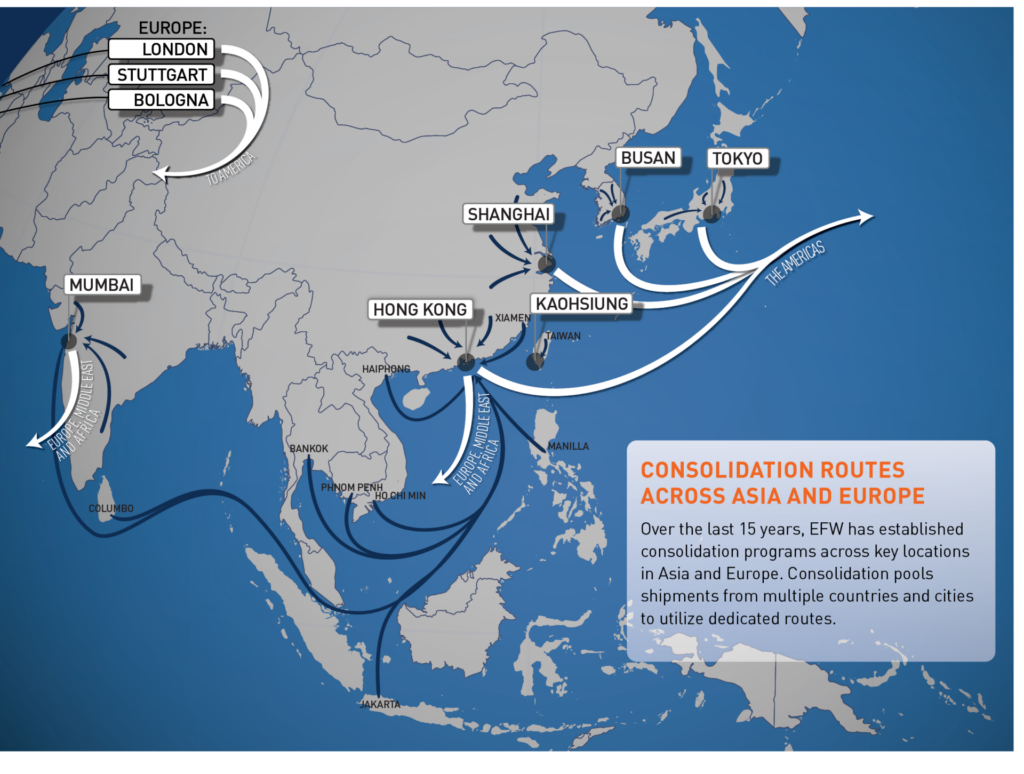
The price tag for moving a single pallet of goods intra-Asia is surprisingly inexpensive when using the short sea vessels moving between Asian ports. As an alternative to pure LCL services between the major Asian and U.S. ports, Estes Forwarding Worldwide (EFW) takes advantage of low intra-Asia costs and offers companies Multi-Country Consolidation (MCC), moving LCL quantities for a single importer from multiple countries, ports and suppliers into its Hong Kong and Singapore consolidation centers.
With this service, EFW builds full container loads (FCLs) for the importer to allow all of its cargo—consolidated over a week or two—to move in an exclusive container to the U.S. or Europe. This avoids unnecessary fuel costs, canal tolls, crew salaries, port fees and other accessorial charges typically associated with LCL shipping. It also minimizes trucking costs at destination and becomes a single-entry, reducing documentation fees and customs clearance (among other charges).
Coming Up with an Innovative Solution
For the shipper that can’t fill an entire container, LCL was historically the only option for Asian imports. Knowing this, EFW came up with the idea to consolidate multiple companies’ shipments with other, similar shipments.
By grouping multiple LCL shipments together to fill a FCL, the EFW Consolidation Program gives shippers economies of scale, faster shipping times and better pricing than any company would be able to access individually. The program was introduced 15 years ago, at which point EFW recognized a gap in the marketplace and decided that a new strategy was in order.
“We had customers moving small, partial shipments throughout Asia and needing help getting those products into a single box,” says Paul Goff, executive VP, supply chain at EFW. “To help, we developed a program that helps shippers consolidate cargo throughout various Asian countries—crossing borders along the way—into single containers for single destinations that are specific to that customer.”
Innovative Program is Still Going Strong
Fast-forward 15 years and EFW is still one of the few global freight forwarders that provide this unique type of multicounty consolidation solutions. Where most freight forwarders have individual offices that are responsible for their own profits and losses, EFW eliminated those silos and operates as a single, global organization that serves its broad client base.
“This has allowed us to take cargo from multiple countries across Asia and move it via LCL feeder vessels into the ‘free ports’ of Hong Kong and Singapore, where there are no customs duty or customs clearance issues,” Goff explains.
All goods imported and exported from these free ports are exempt from customs control and have no trade barriers. Using the EFW Consolidation Program, shippers operating in just about any industry can inexpensively move small, partial shipments of goods throughout the company’s network in Asia (e.g., from Vietnam or Mumbai) to Hong Kong.
The company can build out full 20- or 40-foot containers for five different customers or for a single shipper, depending on the specific customer need. This creates significant cost savings, logistical efficiencies and convenience for shippers that would otherwise have to pay for unused container volume (or, be forced to fill a whole container themselves).
Vast Improvements to an Inefficient System
Before EFW’s consolidation program was introduced, the shipper that wanted to move four pallets of goods from Kaohsiung, Taiwan, had to use a co-loader and have its goods shipped in a container with merchandise from 20 (give or take) of that co-loader’s other import customers. As one of many different companies using the same container, that shipper runs the risk of potential customs clearance problems at the destination port.
“If one of those other customers using that container has a customs issue, you’re now stuck with them until it’s resolved,” Goff explains. The freight then has to be taken to a public warehouse for unloading and further customs inspection. This takes time, costs money and delays all the shipments in the container—yours included.
“We recently worked with a company that was using traditional LCL in a container with other cargo and another shipment on the container got flagged by customs for an intensive exam,” says Morgan Krajco, director of client services at EFW. “That container was held up for a full month.” The company’s production line was down for nearly two weeks as it awaited the cargo that was being held up by another importer. This is just one of many real-world examples that EFW helps companies avoid.
Lower Costs and More Control
Asia’s economic landscape is booming, and inter-regional trade plays an important role in this continued growth. Unfortunately, companies shipping smaller quantities of goods may find that the cost of individual shipments can eat into their profits, create logistical headaches, and impede their sales goals. With its freight consolidation program, EFW offers a cost-effective solution for companies that are shipping smaller quantities of goods.
The scope of this program extends beyond Asia. For instance, if a company is shipping cargo that’s been routed from the Hong Kong consolidation point, that freight is then shipped out in the company’s own container. That container can be routed to Chicago, moving all the way through to its final destination via steamship lines and railroad. It can also be stopped and transloaded to a truck if, say, an urgency arises during transit. This level of flexibility and control far surpasses anything that a company would experience using LCL shipments in a shared environment with other shippers.
As part of its consolidation program, EFW also provides all of the data that shippers need to be able to make better supply chain decisions. From its Taiwan data center “control tower,” EFW orchestrates the complex freight moves throughout Asia to ensure that all shipments move efficiently from one region to the next.
That control tower manages the day-to-day processes that ensure that the right cargo is moving to the right destinations and for the right reasons. It also generates data tracking visibility and reporting transparency that EFW and its customers use for optimal physical freight movement management.
By consolidating smaller shipments from various points in Asia, and then delivering it to free ports in Asia for consolidation, EFW streamlines the process and ensures that one single container always goes exactly where it needs to go, and within the allotted time frame.